What can actually be read
Which parts of this field are open, which are locked, and which are gone
Supplement
A collection like this has two states for any item. Either the full text is attached and a machine can read it, or only the record exists: title, author, date, a link to a page that will not open. Which of the two you get is not random, and the pattern is the most useful thing on this page.
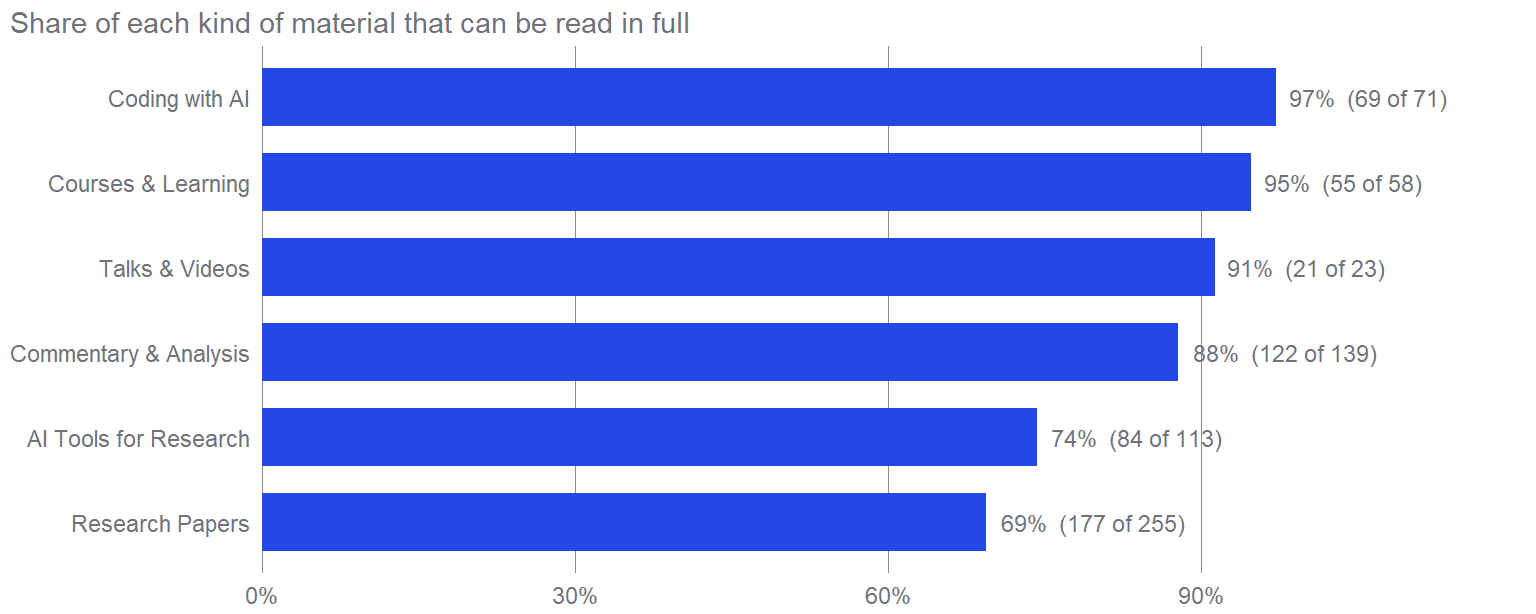
80.1% of everything indexed here can be read in full. That single number hides the story, which is that the informal literature is open and the formal literature is locked. The most authoritative material is the hardest to get at. Guides, commentary and courses reach 85.5% readable, while research papers sit at 69%.
Readable in full, by kind of material
Nothing in that chart is about effort. It is about what a person is allowed to download today. Practitioner material is published on the open web because that is the point of publishing it. Research papers spend their first year or so behind a subscription or an embargo, which is a perfectly ordinary arrangement that happens to make the field’s most careful work its least accessible.
Why the rest is missing
Splitting the same items by why the text is or is not attached sorts everything into six plain situations.
| Situation | Items | Text attached |
|---|---|---|
| Published openly, and read | 548 | 509 |
| A working paper still inside its embargo | 41 | 1 |
| Behind a paywall, a login, or a publisher’s gate | 30 | 5 |
| Not settled yet: nobody has established whether the text can be got | 23 | 0 |
| A door: a page that only points at content, with none of its own | 14 | 13 |
| Gone: the page no longer exists anywhere | 3 | 0 |
The middle row is the one that matters for the argument on this site. Working papers from the NBER series are released to subscribers first and become freely available after roughly eighteen months. They are real research with a real document waiting at the end of it, so leaving them out of the count would flatter the collection. Including them means that indexing the frontier honestly lowers the readable share, and that the share climbs back on its own as the embargoes lapse, without anyone doing anything.
That recovery is one of the numbered forecasts on this site. P10 bets that at least half of the working papers under embargo when the forecast was frozen have a freely findable copy by the end of 2028. Those papers are written down one by one, with title, author and link, so the check in 2028 does not depend on anyone remembering which papers were meant.
The last row is not a failure
Some pages are doors: a lab’s landing page, an “about” page, a call for papers, a menu of links. Most of them do have text attached, which is why that row’s second number is not zero, but the text is a list of links rather than a work. They are counted as records, not as reading, and no claim on this site rests on whatever might lie behind them.